- Price:
- USD $50.00 postpaid (international air mail included)
- Designers:
- Laboratories
- Publisher:
- Seibundo Shinkosha
- Categories:
- Idea + Publications
A note from Idea‘s editor-in-chief:
Without sounding condescending, some of our readers may not be familiar with terms like ‘going live’ or ‘streaming’ in the context of the internet (in fact, I suspect that’s the case for the majority). Just a few years ago, I myself was one of those people. I wasn’t in the habit of watching YouTube, and I certainly didn’t see the fun in watching someone else play a video game online. As for VTubers, I knew of Kizuna AI, but I didn’t understand how she differed from someone like Hatsune Miku, nor was I really interested in any of them. It felt completely foreign to me.
Something happened that changed my perspective, however. I came across a video from Crazy Raccoon Cup, an online gaming tournament hosted by the professional esports team Crazy Raccoon on June 25, 2023. When I say “video,” I don’t mean the actual livestream—it was a “video clip.” As for how I ended up watching it: I was searching YouTube for a walkthrough of a game I was playing at the time, and the clip appeared in a list of recommendations generated by an algorithm. I normally probably wouldn’t have watched it, but the thumbnail showed someone I recognized: professional gamer Daigo Umehara.
I was born in 1980 and grew up playing video games on home consoles and arcade machines throughout elementary, middle, and high school. Once I started middle school I began frequenting arcades, and that’s when I became obsessed with fighting games. At the time, there was a spike in popularity with fighting games, with title after title being released. A wide variety of games came out centered around the Street Fighter series (CAPCOM)—which initially sparked the fighting game craze—and the Virtua Fighter series (SEGA), with its 3D polygon graphics. Every weekend, small community tournaments were held at arcades all over the country.
Daigo Umehara was the first Japanese person to become a professional gamer in the fighting game scene. He’s about the same age as I am (Umehara was born in 1981), and his life journey—the twists and turns that led him to become a pro gamer—is quite a read in itself (I highly recommend you look it up). Even now that I’ve stepped away from gaming, I still keep an eye on what Umehara is up to.
Clicking that thumbnail with Umehara played a clip from an online tournament for the latest installment in the series, Street Fighter 6. Each team consisted of four streamers and one professional fighting-game player, with the pro serving as both coach and team captain. It had been a while since I’d seen any serious game play in the fighting genre, and I was completely captivated by the excitement of the matches. However, to make it clear who was speaking in the clip, icons were attached to the speakers. Three members of the team, including Umehara, had live-action icons, but for some reason, the remaining two had anime-style icons. “Why’s that?” I wondered to myself. This was my first encounter with VTubers.
I did a bit of research and discovered that these two were affiliated with a VTuber agency called Nijisanji (they were Kuzuha and Kanae). Digging deeper, I learned that Nijisanji has nearly 100 other members, that there are other agencies like Hololive and VSPO!, and that each agency’s affiliated VTubers stream on their own YouTube channels almost every day.
While some VTubers disclose their real ages, many do not age. Furthermore, the vast majority affiliated with companies do not own the rights to their avatars or stage names. If they were to end their work as company-affiliated talent, the identity of the performer behind the character—that is, the actual person—would not be revealed (presumably due to confidentiality agreements). In reality, these performers exist; they age, gain experience, face career uncertainties, and make decisions. A disconnect arises however: one between these aspects of their lives and their existence as VTubers.
The fandom supports their efforts. Which leads us to the question: what kind of relationship is formed between VTubers (as described above) and their fanbase? On one side we have visual figures who never change in appearance as they age and, in a sense, remain eternally “present”; on the other are the fans who follow them devotedly. From the fans’ perspective, there’s no doubt they genuinely feel the growth of the VTubers they follow; yet that feeling is purely experiential. Where exactly does this relationship—one in which ‘maturity’ has, in a sense, been stripped away—ultimately lead? I found myself deep in the world of VTubers considering these questions, and in searching for answers, I was drawn ever closer to live-streaming and esports culture.
…This might be a long-winded foreword, but I’d appreciate your patience for a little while longer. I’d like to take the time to clearly explain why I decided to compile this special feature for this issue of the magazine (and if you’re thinking, “Who cares?”, feel free to skip ahead to the feature).
As you delve into streaming culture, you’ll notice that VTubers and streamers are backed with their own stories. With VTubers in particular, viewers are compelled to use their imaginations precisely because they lack a physical presence (an actual body). While avatars—also known as ‘Live2D’ in Japan, from the software that creates them—support their performers’ expressions and movements, voices are the only element that guarantees their physicality. Paradoxically, this limitation reveals each performer’s humanity. Fans recognize the VTuber’s presence in these elements—shifts in vocal tone during casual chats, connection between their movements and the gameplay they’re streaming, and their singing voice in music videos, like the popular utattemita cover songs. Fans will interpret the performer’s state of mind and growth, and create their own stories along with this. Each VTuber’s fanbase is captivated by these stories (even though the fans themselves might be the authors—or maybe precisely because they are).
This story aspect comes to the fore most clearly at events where interactions transcend agency affiliations—such as streamer-participation servers with game titles like Grand Theft Auto V or Rust, or competitive tournaments like the Crazy Raccoon Cup. Rather than viewers chatting to each other, communicating with streamers directly brings out a different side in them than usual. In the latter case of competitive tournaments, the streamer’s own hard work is directly linked to the results. As fans watch them devote themselves to the game, like sacrificing sleep to make the most of their limited time, they often see their own circumstances reflected in their efforts and cheer them on, which further accelerates the narrative.
This dynamic within the fandom is a major factor driving the growth of live streaming and online broadcasting. Fans actively post video clips and fan art of the streamers and VTubers they support on social media, and as these are shared, the fanbase continues to expand. Fan art is often adopted by the performers as stream thumbnails, and it’s not uncommon for fan art to serve as a catalyst for official work opportunities. In fact, many of the creators featured in this special report have secured work through such channels. Behind the design of live streaming and streaming content lies the relationship between performers, their fanbases, and stories they build together.
However, this reason alone wasn’t enough to warrant a feature in IDEA. In terms of fan-created content, it’s no different from traditional doujin works. The deciding factor was watching the announcement stream for the online tournament VTuber Saikyo Ketteisen (championship play-offs) hosted by VTuber, Haru Shibuya.
I watched the announcement for VTuber Saikyo Ketteisen Ver. Street Fighter 6, Event 1, which was held in March 2025 and streamed on Haru Shibuya’s channel. The stream covered the tournament overview and the announcement of participating players and teams, but the promotional graphics clearly bore the marks of graphic design. I kept this in mind when I looked back at the archives of the VTuber Saikyo Ketteisen and the Crazy Raccoon Cup, and it became clear to me that they were indeed deliberately designed. Furthermore, when I took another look at other streamers’ and VTubers’ streaming screens, logotype, and thumbnails with this perspective, I could sense the design awareness there as well. Who exactly is responsible for this design work? If doujin are considered derivative works, then the design of live streams and online broadcasting content is not derivative. However, in terms of its nature, it is extremely close to that of doujin. There is likely significant value in documenting what is currently happening in this field—and that is how I arrived at the starting point for this feature.
While this feature focuses on the design of live streaming, we have incorporated multiple perspectives in compiling it. We’d like to touch on this point to provide readers with an interpretation framework.
Firstly is the structure: we’ve highlighted a total of 18 creators and introduced their work. The selection of creators was entirely subjective on our part, which is why we would like to note that there are still many other creators who could have been included. Even though the selection was subjective however, we made an effort to cover a range broad enough. The 18 creators are loosely grouped based on their creative work, and contributions are interspersed between each groups’ boundaries.
Next is the contributions. When considering the design of streaming and distribution, the economy surrounding the industry is inextricably linked to the topic. The current market size continues to expand. The two industry leaders ANYCOLOR, which operates Nijisanji, and COVER, which operates Hololive, are both publicly traded companies, and collaborations with major corporations in other industries are endless. This economic growth influences the nature of creativity. I must note that the information presented at the most recent shareholder meetings of ANYCOLOR and COVER deeply influenced the editorial perspective of this special feature (detailed content is available online; I encourage those interested to check it out).
Even if we view design solely in terms of color and form—reducing it to notions of beauty, ugliness, skill, and clumsiness—we’re limited in scope of what we can grasp. To understand what is happening in this field, we need to view design from a broader perspective. Which is why we have three articles for you to read, and each offers a valuable perspective for considering the design of streaming and distribution.
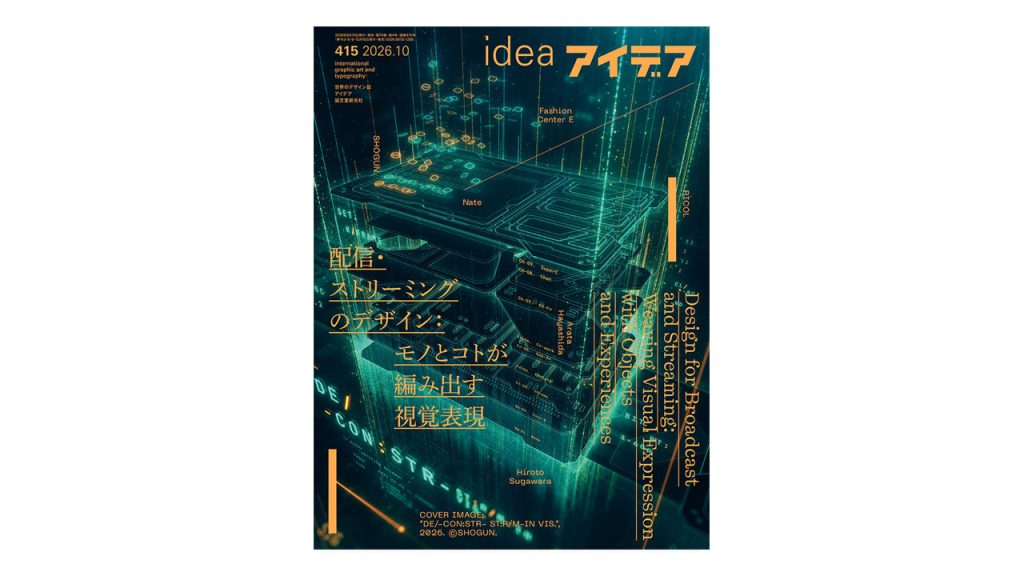
And then there is the title of this special feature. We have named it Design for Broadcast and Streaming—Weaving Visual Expression with Objects and Experiences. While the main title speaks for itself, the subtitle likely requires some explanation.
You may have heard that talk surrounding design has shifted from objects to experiences. The former is sometimes referred to as “design in the narrower sense,” while the latter as “design in the broader sense.” While this shift is rooted in the development of concepts such as design thinking and design-driven management, can design truly be divided into objects and experiences? Objects are accompanied by experiences, and experiences give rise to objects. When it comes to the design of streaming and distribution, if we consider individual, concrete graphics to be ‘objects’, those things evoke the performers’ activities and the connections derived from them—that is, their ‘experiences’.
The act of design, divided into objects and experiences, fundamentally involves the simultaneous emergence of both. This is particularly evident in the design of live streaming and online broadcasting, and perhaps made possible because the creative work in this field is built upon the relationship between performers and their fanbase.
I’ve written at some length here, but please don’t let my long-winded passages deter you—I hope you’ll simply enjoy exploring our issue on broadcasting and streaming design. It’s difficult to clearly define exactly when broadcasting and streaming design began. However, there’s no doubt that we are now at the end of the beginning. I hope that when people look back on this feature from the not-too-distant future, the content compiled here will serve as a helpful resource for future creators.
Finally, I would like to express my gratitude to all the creators, related companies and their representatives, as well as the streamers and VTubers who contributed to the production of this special feature. It could not have been compiled without any one of them. I thank you all from the bottom of my heart.
August 12, 2026 Editorial Director, Toshinobu Nagata
──────────────────────────
Special Feature
──────────────────────────
Design for Broadcast and Streaming
—Weaving Visual Expression with Objects and Experiences
Direction by Toshinobu Nagata and IDEA
Design by LABORATORIES (Kensaku Kato, Sakura Koizumi, Sae Kamata)
Photography by Satoshi Aoyagi
Translation by Duncan Brotherton, Fraze Craze Inc.
006 Yunoki Hanamori
010 Ami Kaneko
014 saku39
018 Nanika Atose
022 Iren
026 Hazuki Tamano
030 zinkai
034 TSCR
052 Fashion Center E
060 Hiroto Sugawara
066 RICOL — Yukinobu Ito, Shota Aoki
074 Nate
090 PUNCH
096 Arata Hayashida
102 Richard Falcema
110 SHOGUN.
──────────────────────────
Interview
──────────────────────────
078 Kaoru Miyazaki
118 Shunsuke Ishigaki
──────────────────────────
Essay
──────────────────────────
038 A History of Streamers & Streaming in Japan
Text by Minoru Hirota
044 ANYCOLOR and COVER: Leading VTuber Status, as Seen Through Their Financial Standing
Text by Kei Yoshikawa
086 How Do We Experience VTubers?
—From the Perspective of Dual Cognitive Activity
Text by Hiroki Yamano
──────────────────────────
Conversation
──────────────────────────
126 Recurrence and Recursion
What worlds will we depict in futures to come?
SHOGUN. × Tomoyuki Arima
──────────────────────────
Series
──────────────────────────
134 Design Atlas: From the European Graphic Design Scene
Part 1: André Baldinger. Visual Laws are Universal
Text by Katarzyna Matul Design by Patryk Hardziej
Translation by Fraze Craze Inc. Edited by Maya Noguchi
142 Poetry and Form
Part 2: Copying, Imitating, Learning — On Alexander Pushkin
Text by Naoya Sawa Edited & Designed by Toshinobu Nagata
150 Designing to Live in a Progressive Space
Part 2: The Autonomy of William Morris
Text by Ichiro Saga Edited by Toshinobu Nagata Designed by Daisuke Kano
158 undsoweiter
Wolfgang Schmidt 1929–1995
Text by Markus Weisbeck
Design by Kazuhiro Yamada + Akiko Takeo (nipponia)
Translation by Fraze Craze Inc.
──────────────────────────
Exhibition Review
──────────────────────────
166 Movement on the Plane:
Reflections on “Kota Iguchi Motion Graphics”
Text & Design by Toshinobu Nagata
Photography by Mitsumasa Fujitsuka
Cooperation: ginza graphic gallery
──────────────────────────
174 Book
175 Information